Some poems, prayers, and stories from a dude just trying to find his way to heaven.

  • The Vase

    A vase sat upon a pedestal

    Reflecting light

    Its shining surface shone all aglow

    Defying night

    A servant now worked, cleaning the vase

    With careless hand

    Now the masterpiece fell from the base

    Off of the stand

    Upon the ground it did shatter

    Countless pieces

    Beauty unmade into base matter

    No More priceless

    The servant trembled with fear and shame

    Proclamation

    The King damned and cursed the servant’s name

    Condemnation.

    Then the Potter came.

    In the servant’s mind, fearful dread grew.

    Over the vase,

    He spoke, “Behold, I make all things new.”

    He beheld grace.

  • Heartquakes

    My heart quakes

    Thunder rends the skies

    My soul shakes

    Water fill my eyes

    My mind makes

    Murder of the ones I despise

    My strength breaks

    Further from broken cries

    Where is the One I love?

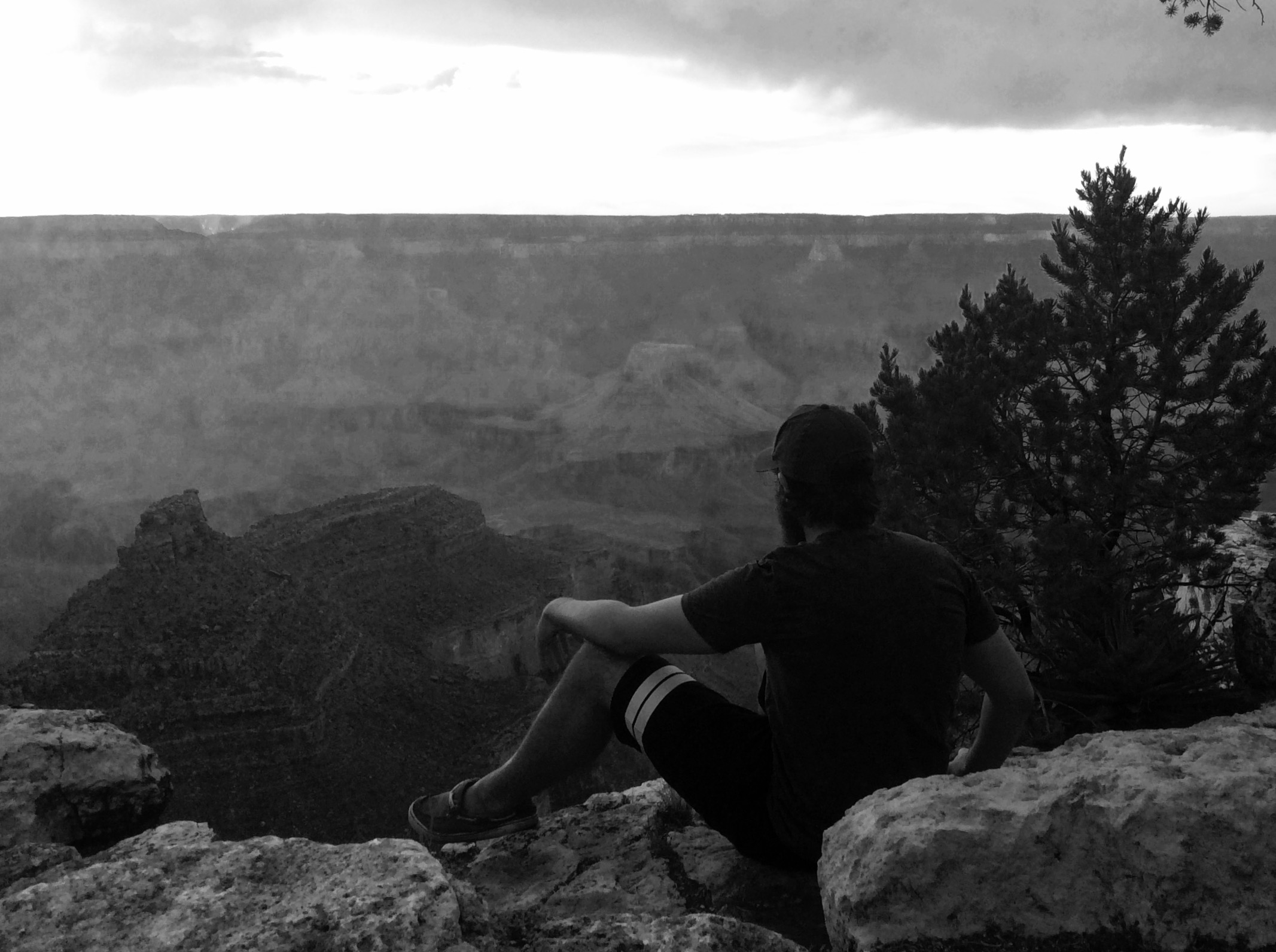
  • Man’s Face

    Long have you looked

    Set in stone

    Forever forsook

    All alone

    Beholden to all below

    Withering with weather

    Sad ‘n slow

    All alone

    Where do you look?

    Beyond the butte?

    Lifeless lands

    All alone

    Looking at you long

    Set in stone

    I see myself

    All alone

    Whither to wither

    or endure

  • The Spectacle 04.08.2024

    The clouds coated the sky in mundane gray as I made my way to the lawn. Hordes of spectators spread across the slope waiting for the spectacle. Some blasted music; others played frisbee. Some carried on in conversation; others sat in silence. All hoped the clouds would soon clear so that all could behold the coming revelation of the heavens.

    After several minutes of searching and weaving through the multitude, I staked a spot where I could place my lawn chair. Though its hinges were stiff from lack of use, I was soon seated amidst the anxious crowd. Many began to check the time on their phones, followed swiftly by a check of the weather. Would the clouds roll away in time?

    The minutes ebbed away. Anxiety rose. Soon a hive-like discussion of the weather buzzed up and down the hillside.

    A sigh of relief exhaled from the crowd as a fierce wind began to drive away the obstructing haze above. Soon all began to clap and cheer. The moon’s rim had just kissed that of the sun’s.

    I too smiled. This lasted but for a moment. A scream escaped my throat from the place within that cages all the unthinkable terrors we dare not face. Ice shot down my spine as sweat swept like a tide over my skin. Yet, the crowd carried on its celebratory cheer.

    What had aroused such fear in me was this: though the moon was adjacent to the sun in the sky, she was in her full face, every crater lit in full detail across her white surface. Everything we had been told, everything we had believed was horribly wrong. I trembled and questioned everything, not even trusting the words with which I questioned.

    A man beside me, wearing a t-shirt and sunglasses, waved his beer bottle dismissively at me. “Would you quit your jabbering and just enjoy the spectacle?” as the crowd continued its celebratory cheer.

  • A Late Autumn Day

    As I observe the late autumn day

    I see the trees in their longing sway

    Though their glory has fallen away

    Upward to the Sower do they pray

    “Come oh, Lord, our withering stay

    Come in endless, blessed ray.”

    So shall I await the Day.
  • The Wolf Who Cried Boy

    The wolf caught a scent on the breeze which made hunger explode within. It was the scent of young flesh. Silently he stalked between the trunks of the spruce trees he knew so well. He passed the bones of a previous meal. This would be far from his first victim.

    Soon the wolf heard the sound of the stream. He was near the village which had often provided his previous meals. The wolf slowed and listened. He heard a shrill, youthful noise burst through the air. To the owner, it was giggle of innocent joy. To the wolf, it was an invitation to feast.

    The wolf crept to the edge of the trees which lined the stream. There he saw a small boy, no older than two winters. The boy was splashing in the little stream. The wolf salivated. He knew exactly how he would acquire his next meal; the young were so simple to ensnare.

    The wolf placed himself behind a bush. He then let out a beautiful, soft, short, high noted call from his from his throat.

    The boy’s curiosity overtook him. He walked cautiously toward the bushes; though, his caution would not save him. He walked straight towards the jaws of death. He could not help doing so; it was his nature.

    The boy was within ten feet of the wolf. Hunger and the desire for blood overcame the wolf. He leapt over the bush, flying through the air, jaws aimed straight at the boys throat. A fierce force of hunger hurtled at human innocence. He could not help doing so; it was his nature.

    The blade of a spear slammed through the wolf’s throat and severed his spine as the wolf was hurtled back into the bush.

    The father ran to the boy who was otherwise fine beside a small, single scratch. The boy was crying from the pain. The boy had never saw the wolf; he had only felt the scratch and heard the scary sound of the body crashing through the bush. The father picked up and comforted his child; it was his nature to do so.

  • Brighter

    Still, away from my faint sight

    Shining, shimmering, burning bright

    Shaping the universe in immense might

    Beautiful and beyond remains the light

    For the light defines the darkness

  • Dimmed

    I saw the sun set beneath the darkening sky

    It was then I thought all a lie

    Color softly faded from mind and eye

    There in the dark, alone stood I.

    Why must the light leave?

  • The Fall of Telegon and Kor

    I. Memory Awakened

    Telegon and Kor, bravest of us all, no song can fully tell the sorrow of your fall.

    For the name of Egon, with Degon you fought. Yet, you knew not of the miseries that Dragon would wrought.

    Long before ye did his fires burn with hate. And many a innocent babe did they incinerate.

    And in that dark hour that was so late, you did not fear your impending fate.

    Here in the measureless lengths of time is the setting made for the rhyme.

    II. The Dragon Takes Flight

    In the isle of Degon, there lies his cave. A place we’re only a pure soul may brave.

    Here the Dragon doth sleep in caverns unfathomably deep.

    Temporarily is this evil kept at bay while Anveillion is ignorant as it sleeps day to day.

    But this is all part of Egon’s plan, part of the cycle to break the enchantment of man.

    Degon awakes, thus, and takes flight; foreshadowing for Anveillion a hellish fight.

    III. The Resolve of Kor

    Brunesburg set upon the moonlit moor, over watching it was the grim knight, Kor.

    Rarely did that town succumb to fear so long as Sir Kor wielded his spear.

    It’s shaft was strong and heavy. More firm still was the arm that held it steady.

    He was Brunesburg’s watcher of the night, appointed to protect the town from any dark plight.

    Countless a dark hour did he spend, watching the town he had sworn to defend.

    IV. Degon Descends 

    In one such hour, doomed as Kor’s last, the dragon did descend with a fiery blast.

    Kor raised the alarm to awaken all, and to warn them of the dragon soon to befall.

    But the dragon was quick and already devouring his prey, and no few persons that night did he slay.

    Kor rushed toward the dragon with lightning quick reaction.

    Though, Degon was shrewd, and more so was he fast. As he turned to Kor, a deadly gaze he did cast.

    V. Kor Faces Degon

    There was a pause, but no words were spoken. All too soon, the stillness was broken.

    Kor, with his spear, fiercely stabbed; Degon, with his teeth, rapidly jabbed.

    Wondrous was the skill of Kor; he fought as no knight ever before.

    Yet, Degon, the dragon, was fiercely strong; and was soon to do Brunesburg a terrible wrong.

    With deadly accuracy, he slashed with claw; slicing Kor beneath the jaw.

    VI. Kor’s Final Deed

    Kor’s throat was open, and like a flood, his armored chest was covered in blood.

    But, his heart still sparked with life. And, upon Degon, he would inflict much strife.

    Kor lifted his spear with a weary hand, ready to make his final stand.

    Kor steadily took skillful aim at Degon’s throat, from whence the flame ever came.

    And with that final deed, Kor’s soul, from his body, was freed.

    VII. Telegon Hastens to Battle

    Far before a cry for help was heard, Telegon rushed to battle without a needless word.

    Onward he ran, taking not his shield; for time was pressing and a sword alone did he wield.

    With billowing smoke, the air was thick. Nevertheless, Telegon’s pace was quick.

    Though appointed Brunesburg’s knight of the day, no evil would Telegon abide to stay.

    But, alas, his coming was late. The brave Kor had met his fate.

    VII. Telegon Addresses Degon

    Then, Telegon, full of wrath, spoke cold words to the fiery dragon in his path.

    “Degon, serpent, vile worm; I bid thee, be gone; for my arm is still firm!”

    To which Degon did reply deadly words to make a lesser man fly.

    “The Knight of the Night may have brought death to the white hot fire in my breath;

    “But Him I did gruesomely slay; as I will you, petty Knight of the Day.”

    IX. Telegon’s Last Battle

    Then Telegon did rush at the foul beast who, upon the citizens of Brunesburg, was making feast.

    With his precious blade he swung, and, upon the dragon’s scales, it loudly rung.

    Many a skillful stroke did he pass. But, he could not cut through the great serpent’s mass.

    Degon quickly struck with spiked tail. Telegon’s breath, thus, then began to fail.

    But, Telegon shrewdly plunged upward his steel; inflicting on Degon a wound that would never heal.

    X. Brunesberg Flees

    While Kor and Telegon fought in battle, the people of Brunesburg stampeded like cattle.

    No other man stayed to fight; they, like animals, all took flight.

    The swords, forged by Great Egon, now appear to all be gone.

    This is due, in part, to vile Degon; who slew the Great Kor and Mighty Telegon.

    Who will now break the enchantment of Degon, and bring us to the blessed realm of Egon?

  • Some Secrets Must Be Shouted

    My heart is darkened with the passing of a thousand storm clouds. My soul begins to dissipate into the churning wind. My mind freezes in fear of the thunder. My strength fails with the falling of the rain and hail. Everything that I cling to begins to wash away along with the dirt beneath, from which I am made.

    The storm presses ever on; perverting light into its own cruel shades with its coming. With every pulse of my heart, clouds amass into an ever darkening wall of oncoming might. The sky thickens and swells like the very blood in my veins. Light fades, for there is none within myself as the storm presses ever on.

    The storm presses ever on; its winds blow so fiercely that even my inner being is torn apart. All that I have beheld as stable and sure within me is toppled and turned. There is no longer any absolute to hold onto; for I am held by a million arms, each pulling in a different direction. Stillness and calm are forgotten, for there is none within myself as the storm presses ever on.

    The storm presses ever on; its thunder transcends my conception of power. Every blast brings an increasing revelation of might. So full are the rumblings that my very consciousness pales in comparison to the faintest passing note. Awareness is no longer compatible with coherence, for there is none within myself as the storm presses ever on.

    The storm presses ever on; its contents pelt the entirety of my being. Icy drops set my nerves on edge; cold stones break every inch of my skin. In perfect unison with gravity, they drive me into the mud from which I am made. Effort, and the energy with which to execute it, diminish; for there is none within myself as the storm presses ever on.

    Everything of my composition is being laid to waste. My heart screams; though, my tongue is silent. Words seem arbitrary compared to the toil and strife within. Thus, confusion further ensues. Why the pain? Why the sorrow? Why this relentless desire to exist in stark contrast to my current affliction? All that I once told myself is drowned out by the ever pressing storm.

    The clouds blot out all. The wind races on. The thunder shakes the ground. The rain and hail ever fall.

    And the storm presses ever on.

    But if it were not for some source of light, I would have never beheld the clouds.

    If it were not for some source of gravity centering me, I would not know the pull of the wind.

    If it were not for some source of deep wonder, I would not know the might of the thunder.

    If it were not for some desire to be comforted and loved, I would not know the pain of rain and hail.

    Thus, even as the storm presses ever on, my Maker ever calls out to me.


  • A Faint Breath Into the Wind

    As it were; I stood upon the cliffs before the sea under the vast canopy of space. I breathed out into the vastness before me to be answered by the wind that drives all the sails of every ship that bears every sailor to the solid ground from which all come.

    The Breath Inhaled

    Why is it that all that is, is? To what quality is everything bound? Can anything be that is not? Why is all that is contingent to being? Why must everything, in order to exist, be?

    From what does everything come? What is the foundation of all? To what depends the quality of independence? What is that was not was?

    What is the end of all? To what state will all things conclude? Is there a destination to all that is in motion? Is there ever conclusion?

    From where did order come? To what standard is existence measured? How is the quality of relative defined?

    What was the beginning point of matter? In what manner will it become uniform? How was energy set into motion? To what end is it working?

    What made the transition from inanimate to animate possible? What caused life to appear from that which was lifeless?

    What caused life to have sensory awareness? What is it that living beings were meant to feel? What is the internal to learn from the external?

    To what conclusion does the consciousness so desperately seek to be aware of? At what final understanding does the mind work so hard to comprehend?

    How is truth defined? What makes the actual understandably factual? What base makes a proposition justifiable?

    How was it that desire arouse? What caused perceived need within the mind? What was lacking? What was not seen as full?

    The Breath Exhaled

    What did I come from? What defines me? What will my conclusion be?

    What causes me to stare at the vastness before me with an overwhelming longing? What will bring final resolution to my discontented being? What will bring satisfaction as I aimlessly search the infinite gaps between pain and pleasure; never knowing what has sent me searching so desperately for meaning? In all my joys, what is that which I have so earnestly sought to sustain the fleeting glimpses of unknown, incomprehensible, unreachable perfection? In all my sorrows, what was it that the pits of my soul cried out for in utter desperation for restoration? When I saw the emptiness of everything, and turned to look away, what was I looking to see? When I realized the degree of my imperfection, the profound horror of my very own existence, what was the object by which I measured myself? When I realized my treachery, what did I realize to be sovereign; the thing I had betrayed?

    The Wind

    “. . . I AM THAT I AM . . .”


  • A Story of a Yearning Heart that Knew Not For What It Longed

    “Father, why can’t I?”

     This typical plea of adolescence was heard in the streets of the capital’s marketplace garden. “Father, it isn’t fair that all the other fathers buy their daughters roses when they come to the capital, but I have yet to receive one,” continued a young girl’s emotional reasoning. Her Father, a man of significant wealth, in turn, gently refused her request. “Now, dearest daughter,” he said, “you know very well that I love you. I work very hard to provide you your meals. I have had a house built so that you and I may dwell safely together in relative comfort. And never have I sought to make you miserable for the sake of misery. But I will not purchase, beautiful as it may be, a flower for you at the capital. Come, let us finish gathering our groceries here and then my business with the venders. Tonight I shall make you whatever meal you desire. And then tomorrow we shall set our eyes for home.” 

    The daughter made sign outwardly that she consented, but in her heart she was still bitter; though she dare not show her father. She loved her father, but sometimes she just could not understand his reasoning. 

    It was customary, in her country, when a girl had come to age that her father would buy her a rose upon her first trip to the capital. This was done, typically at age 14, to show that the father acknowledged his daughter’s coming to womanhood. The girl of this story was 17, had been to the capital multiple times throughout her life, and had yet to receive a rose. This had been the first time she had confronted her father openly on the subject. And many times before she had hinted at the prospect of his consenting to give her a rose but to no avail.

    Inwardly, she began to doubt her father’s opinion of her. Why had she not yet received her rose? Was it because he did not yet think of her as mature? Was he ashamed of her? Albeit, he had always treated her kindly. He was never upset with her if she gave him no reason to be. And even if she did, he was always loving and fair. But was this all an act; a means of hiding some inner disappointment with her? 

    She had never known her mother, for she (the mother) had died in childbearing. As it was, she (the daughter) was the only child born to her father; and he had raised her alone. Was he let down that she was the only family he had? Did he wish she had been a son (which was admirable in that society) instead of a daughter? Was she merely a tolerance out of obligated charity?

    Her father had always made an effort to make himself present while she was growing up; though his business often took him away. Now that she was older, he would often go away on lengthier business trips. Yet, she was still never left wanting. He had hired servants to help her manage the estate while he was gone. And if she was ever felt lonely, she had many pets to care for and play with.

    Often her father’s business would take him to the capital. Whenever this was the case, the daughter would beg to go with him. In these instances, he would often deny her with a tender smile. But, as she grew, he would begin to allow her to accompany him more frequently; for it pleased him to have her company in his growing age. Once the daughter had received permission to join her father, she would inwardly hope that this would be the time she would receive her rose and the, much coveted, formal admiration of her father along with it. 

    She highly loved and respected her father. He was constantly working, but never failed to put her first. This made her love for him continually grow as she matured. Every time they would make the venture to the city, he would wake her in the early hours of the morning. She would find the cart was already packed; though the sun had not yet risen. Never did he ask her help; he simply prepared all that was needed. All she had to do was travel with him.  

    It was because of how much she respected him that she feared his disapproval of her. It was because of how she much she loved him that she longed for his formal approval. 

    “I’m going to go do business now with the vendors. Why don’t you go and purchase food for our dinner tonight,” said the father with a loving gaze as he handed his daughter a few gold coins. “Yes, father,” she said with downcast eyes, for she now felt guilty of her bitterness in light of his kindness. 

    He would always allow her to go do something more to her liking when it was time for him to do business. She was always grateful for this, for it gave her time to experience all the sights, smells, and sounds of the capital without the hindrance and weight of business.  

    Later that evening, they reconvened at the inn in which they were staying. As promised, the father prepared a hearty supper for his daughter. After the meal, they briefly made plans for the trip home; then parted for bed.

    The daughter was awoken by sunlight in her eyes. Had she slept in? She had. Why had her father not awakened her? She then saw him sitting in a chair, reading as he would often do.

    “Father, why did you not wake me? I thought it was your aim to get an early start,” she said.

    “Ah, yes. Something has come up, and I have had to slightly change plans. There is some business I must immediately tend to, and we cannot go home today. I’m afraid you will have to come with me seeing as it is outside of the capital,” said the father (for it is a very foolish thing to leave a lady alone in any foreign city). 

    Around noon, they loaded themselves on the cart and travelled out of the city. When they were aways down the road from the city, the father said, “Reach under your seat and open what you find there.”

    The daughter felt a smooth flexible object wrapped in packaging paper. She opened it, as her father instructed, to find a beautiful dress with many roses eloquently stitched around it. Her face beamed with joy, and she thanked her father many times. He simply smiled with his gentle face and said, “You are most welcome.”

    She no longer doubted that he respected and loved her. Though he had not done the traditional act of giving a rose, she now knew that it was foolish of her to desire an act of formality when he had clearly cherished her for her entire life. She said, “Thank you” one more time. He simply chuckled, and with that she fell asleep on his steadfast shoulder.

    * * *

    When she awoke, she saw they were approaching the fork in the road that would lead home. To her left, she could see their estate down in the ever familiar valley where she had been raised. To her right, she saw the ever ambiguous mountain that loomed eternally. The sun was setting. Her father urged the cart to the right.

    “Father, why are you going toward the mountain when home is in the valley,” she asked.

    “I told you, there is some business I must tend to. And this is the road I must take,” he said with a slight laugh.

    She became nervous. She had never been on the mountain and knew of no towns beyond it, for it was large and impregnable. Why had he not taken her home? Night was falling, and it would be dangerously cold on the mountain. Her nervous state turned to fear.

    The road on the mountain (if road is even an appropriate word for that broken path) wound ever up; seeming endlessly towards the summit. They travelled on for nearly two hours under the clear light of the stars, though there was no moon to navigate by. A harsh wind was blowing with biting cold. The daughter regretted coming and questioned whether she would join her father on his next “business” journey. 

    She tried to sleep and would often doze off. But between the cold and the continual jerking of the cart on the rocky path, sleep was an impossible task. Her discomfort subdued her fear to callousness; and callousness to anger.

    “How much further are we going to travel in this frigid darkness,” she asked with an attitude that more than conveyed her disdain.

    “About another half hour,” said her father in a steady voice.

    And so for another half hour they traversed onward up the mountain. When they had done so, the father guided the cart off of a slight bend in the path. In the dark, the daughter vaguely saw a pad of dirt with a small fire ring in the middle. After gathering some of the blankets for her from the cart, the father started a fire in the ring and bid the daughter to lie down and get some sleep. She did so with a scowl.

    “Tomorrow I’ll be finished with my business, and then we’ll head home. The descent will be much easier,” said the father. And with those words she bitterly drifted to sleep by the fire.

    * * *

    “Get up,” came a voice seemingly minutes later. The daughter opened her eyes. The stars were still out and the sun had not yet risen. The fire had smoldered, and the cold had returned. Frost covered her blankets; anger kindled in her heart.

    “Why did you drag me up this mountain? I am likely to get sick exposed to this cold, and your business is no business of mine,” she yelled shivering on the frozen ground. 

    “Get up,” was all he said in return. With a loath full sigh, she flung her things into the cart and took her seat. Her father said nothing. She could not make out his face in the still darkened sky. 

    After they had traveled an hour, dawn began to make its daily flirtation with the black night. Just as the dawning the sun’s light brought revelation; so now she perceived reality. She was just now seeing the true nature of her relationship with her father. 

     She looked down and saw the valley she called home. She longed to be there above all other places on earth. Even more so, she longed to be any place on earth but here.

     She looked at her father and wished she had a normal life; that she had known her mother; that her father would work a normal job that would bring him home every night. She wished that he simply would love and acknowledge her the same way other fathers did for their daughters. 

    She looked down and saw her dress. Though it had initially brought her joy, she now resented it. It now symbolized an abnormal love. Her father may have been trying. But effort alone does not guarantee the fruition of a desired result. He could not love like others; therefore what he called “love” was not the real thing. One can be kind but still distant. 

    A thought popped in her head saying, “Your exaggerating; he loves you.” She denied it. Their relationship was cold and hard; like the mountain.

    They approached a fork in the path. “From here, we walk,” said the man.

    She no longer cared. She simply did as she was asked; as she had always done.

    * * *

    They came through a crevice in the mountain, and, Oh, what she beheld! The bright morning Sun burst forth upon a vast plain possessing a brilliant spectrum of color! Roses upon roses were as far as her eye could perceive. If that which is true beauty was capable of being recorded in mere words, here it would be written. But as that is not yet the case, but only ever so elegantly teased at by the author of the author, it will be attempted nonetheless (but only as the promise of words leading to the desired fulfillment of truth by which the words exist).

    Her eyes welled with tears. Her heart broke with awe. For here was beauty that was beyond her; that her bitter, broken eyes should never have beheld. 

    “Here is where I gather the roses to be sold at the market. No one had ever seen a rose until I found this meadow. After I had retrieved one for your mother, everyone desired one. It has since been a symbol of beauty. I never gave you one because I wanted you to see this place with the purity of having never beheld even a hint of its beauty; just as I did the first time. But you were not old enough to make the trip till now. This is where I come. This is my business,” said the father.

    Tears streamed down the daughter’s cheeks. Her father did not love her the way other fathers loved their daughters. His love was greater. By him, fathers were given a means to display their love for their daughters. But to her, the very source, of this love, had been saved and given.  

    She no longer wanted a rose. She knew from whom they all came.

    Written on September 30, 2016, in light of my struggle with singleness.
  • The Rushing Wind

    He sat at his desk; fingers twitching, waiting for a gust to propel them to craft something great upon the screen out of the pathetic keys that laid before him. 

    But nothing came. That is, except the deadline, dread, depression, and despair that ever haunted his headspace. Palms braced brow as tears pooled. He had nothing to say which had not been said before by poets, prophets, and polymaths more prominent than he.

    Then it came; his emptiness the catalyst for some higher greatness. His broken state became a conduit of grace. Fingers flicked as thoughts flowed. His realized depravity became a means of redeemed creativity.

  • It’sagoin’

    Where’s this world going?

    Where’s my life going?

    You ask, “How’s it going?”

    I reply, “It’s going.”

    Don’t know where it’s going

    Don’t know where it’s going

    But

    Night is going

    Lust is going

    Sin is going

    Death is going

    I am going

    And

    Life is coming

  • The Station

    “Welcome to the department, Officer Hayes. You’ll be riding along with Officer Brandt today to familiarize yourself with the town. We pride ourselves in our low incident rate: we’ve never had a recorded murder, rape, or felony theft in our town’s long history. I’d presume it’s going to be less exciting than the city pace you’re used to.”

    * * *

    “I think a pretty girl like you has nothing to worry about here, presuming you cooperate with those of us who keep things running. Just do what you’re told when you’re told to do it, and you’ll be taken care of.”

    * * *

    Richard Hayes walked out of the conference room with his new partner Kyle Brandt. They were out of the small department building and in the patrol car within a matter of seconds. This would indeed be much different from his previous post where the building alone took almost half an hour to navigate from the parking lot to the many meeting rooms. A smile crossed his face at the thought. This was indeed shaping up to be a slower pace.

    “How long were you in the city?” asked Officer Brandt.

    “Pushing ten years,” replied Richard.

    “I imagine you saw a lot of things in your time!”

    Richard assessed his partner. He was middle-aged and slightly overweight. His uniform was presentable, but Richard’s critical eye caught the many areas in which it was fraying. Brandt was a soft man who had probably never feared for his life. His tone conveyed that he wanted to know about the rush their occupation carried potential for but had yet to deliver to him.

    “Yeah, a thing or two.”

    After a minute of silence to see if Hayes would say more, Brandt changed subjects and began giving the lay of the land.

    “It’s really a simple town. There’s only two neighborhoods (one to the east and one to the north) and main street (which you’ve seen now).”

    Hayes looked to the south. A little over a mile away was a large, run-down building.

    “What’s that over there?”

    “That’s the old train station. Only Riffraff goes there. But they’re not our problem cause it’s outside of city limits. Most of them are just passing through, though there are some permanent residents. They all know to stay over there and they have nothing to worry about from us.”

    Hayes nodded in understanding as he watched what looked to be a young girl enter the building.

    * * *

    Hope looked around the building. Her previous two years on the run from home had culminated in her arrival at this rancid place. Men, whose ages could not be guessed by the wear of years or substance or both, brandished smiles of broken teeth. Many stood up as she passed. Their eyes leered at her with lust, like vultures encircling the contours of her figure.

    As she continued to take in the scene, she began to realize no other women were present. Her heart began to race. Was there no solace for her in this world? Was there no place of rest? Of healing? Or just safety? Every promise of freedom had only made her more dependent; every perceived pleasure was a purchase of pain.

    Then she felt it. A needle jabbed her in the neck from behind. Her mind began to swim, though, in her broken soul, she knew what was about to happen.

    * * *

    Hayes approached the station as the sunset. As he entered his eyes confirmed what his ears had already guessed from the jeers and moans.

    A group of six pantsless jackals surrounded a girl of no more than fifteen as they simultaneously presumed to have their way with her.

    Their presumption ended as Hayes snapped his revolver out. 

    Six shots boomed as six bullets struck six bodies spilling blood.

    Hayes picked her up off the floor. He knew she was the one he had been sent to find. 

  • Collier Park

    With grass so green

    And trees so tall

    With sunny gleam

    And space for all

    Here, in Collier Park, I will stay

    And mark the passing of the day away

    An artificial paradise in a dry desert of death

  • Glasses

    Put my glasses on in the dark
    They did not help me to see
    Have to hope when the light comes
    This faith won’t be for nothing
  • The Cage

    I go back to work tomorrow

    Stealing time I can’t borrow

    Only there because none can see

    Any value in me

    They’ll hire during peak

    Then fire when I’m too weak

    I can’t take care of anything

    I am the definition of failing

    Tell me what is the reason

    For this neverending season?

    I am getting so exhausted

    And that flame, I’ve almost lost it

    No longer know my purpose

    So I spit puny verses

    It’s a waste of a page

    They’ll never see a stage

    I’ll die in the cage